
AI Disclaimer
Portions of this blog entry were written by AI by referencing my source code, chat conversations, and documentation about the process
In modern web application development, security is typically modeled using static paradigms: Role-Based Access Control (RBAC) or Attribute-Based Access Control (ABAC). While these paradigms are well-understood, they often struggle in highly dynamic, real-time, or distributed environments where capabilities must be dynamically delegated, revoked, or transferred between processes.
To solve this, we can turn to the π-calculus —a mathematical framework designed to model concurrent, communicating systems whose network topology changes during execution.
This post covers the foundational theory of the π-calculus and explains how we built a working prototype (pi-ui), a Blazor-based dynamic UI simulator that translates formal process calculus concepts into real-time, capability-based frontends.
1. Foundations of the π-Calculus
Developed by computer scientist Robin Milner in the early 1990s as a successor to CCS (Calculus of Communicating Systems), the π-calculus is to concurrent computing what the λ-calculus (lambda calculus) is to sequential computing.
Rather than focusing on functions and evaluating expressions, the π-calculus focuses on processes interacting via channels.
The Core Syntax
In π-calculus, we describe systems using processes (P,Q) and names (x,y,z). Names represent both communication channels and the values passed over them. The core syntax includes:
- Output Prefix: xˉ⟨y⟩.P
Send the name/channel y over channel x, then continue running as process P. - Input Prefix: x(z).Q
Receive a name over channel x, bind it to the local variable z, and continue running as process Q (where z can be used in Q). - Silent Action: τ.P
Perform an internal state change, then continue as P. - Parallel Composition: P∣Q
Run processes P and Q concurrently. - Restriction: (νx)P
Create a new, unique private channel x restricted to the scope of process P. - Replication: !P
Create infinite concurrent copies of process P (used to model loops or servers).
The Power of Dynamic Topology (Mobility)
The defining feature of the π-calculus is mobility: the ability to pass channel names over other channels.
Consider this reduction rule (β-reduction/reaction):
When an output process on channel x interacts with an input process on channel x, the channel name is transmitted. The receiving process Q substitutes z with y.
If Q did not previously know about channel y, it now has the capability to read from or write to it. This dynamic rewriting of the communication graph allows processes to pass access rights, establish private links, and dynamically restructure the software architecture at runtime.
2. Architecture of the “pi-ui” Prototype
To demonstrate this theory in a web application, we created a demo prototype called pi-ui using C# and ASP.NET Core Blazor. In this system:
- π-Channels are treated as capabilities. Knowing a channel name grants the privilege to view a UI component or perform an action.
- Structural Reduction dictates layout rendering. If a user does not possess an active channel, the UI process reduces to the empty process (0), suppressing the rendering of that interface block.
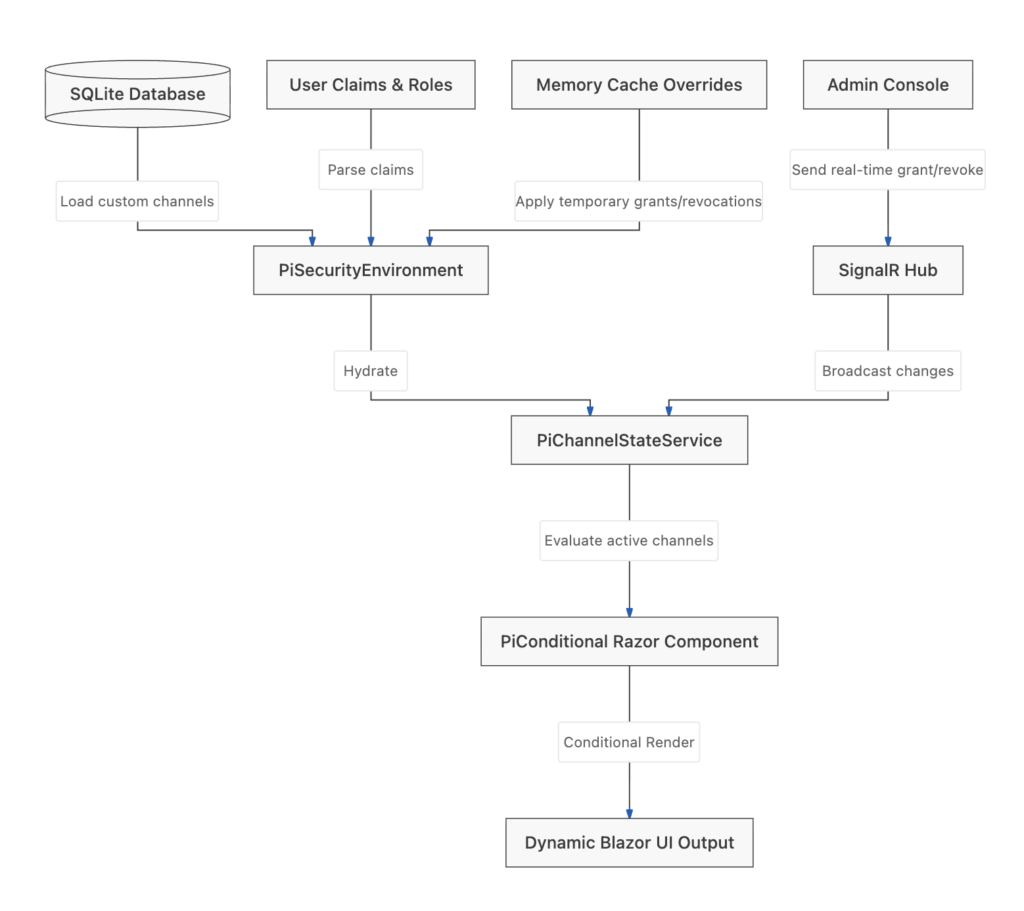
Here is how the components interact under the hood:
Key Technical Components
PiSecurityEnvironment: An environment manager that translates an authenticated user’s identity claims (roles, permissions), custom channel assignments stored in the database, and real-time administrative overrides into a set of active capability channels (e.g.,chan_view_dashboard,chan_edit_profile,chan_view_metrics).PiChannelStateService: A client-scoped state provider that tracks active, base, and revoked channels. It exposes events that components subscribe to for reactive UI updating.PiConditional: A declarative custom Razor component wrapper:<PiConditional ChannelName="chan_view_sensitive_data">
<!-- Secure UI Components Go Here --></PiConditional>
If the channel is active inPiChannelStateService, the child content renders. If it’s revoked or inactive, structural reduction is simulated by returning nothing (_isActive = false).
3. Dynamic Channels and Channel Assignments
To make the system truly representative of the π-calculus, channels are not static hard-coded permissions. They can be assigned, delegated, or revoked dynamically.
Database Schema and Entity Configuration
In ApplicationUser.cs, we represent channel assignments directly on the user entity:
public class ApplicationUser
{
    public Guid Id { get; set; }
    public string Username { get; set; } = string.Empty;
    public string Roles { get; set; } = string.Empty; // e.g. "Admin,User"
    public string Permissions { get; set; } = string.Empty; // e.g. "EditBio"
    public string AssignedChannels { get; set; } = string.Empty; // Comma-separated list

    public IEnumerable<string> GetAssignedChannelList() =>
        string.IsNullOrWhiteSpace(AssignedChannels)
            ? Enumerable.Empty<string>()
            : AssignedChannels.Split(',', StringSplitOptions.RemoveEmptyEntries | StringSplitOptions.TrimEntries);
}
The Security Pipeline & Resolving Capabilities
When a user logs in, the PiSecurityEnvironment calculates the available channel set by combining:
- Static Mappings: Roles (e.g.,
Adminautomatically maps tochan_admin_settings,chan_view_metrics). - Explicit Permissions: Specific capabilities (e.g.,
EditBiomaps tochan_edit_bio). - Dynamic User Assignments: Custom channels assigned via the DB (
AssignedChannels). - Runtime Cache Overrides: Channel status overrides set by administrators for temporary testing.
Real-Time Delegation via SignalR
When an administrator toggles a channel assignment on the dashboard, the application:
- Saves the new
AssignedChannelsstring to the database using Entity Framework Core. - Recalculates the user’s active capability channels.
- Broadcasts the update via SignalR to all active client sessions using
IHubContext<PiProcessHub>:
await HubContext.Clients.All.SendAsync("UserChannelsUpdated", username, activeChannels, baseChannels, revokedChannels);
Clients listening to this hub stream automatically update their local PiChannelStateService instances, triggering an instantaneous, smooth UI transition without requiring a page refresh.
4. Reflection and JSON Schema Generation
The prototype also implements self-documenting capabilities. By utilizing custom C# attributes, we map domain models directly to their corresponding security channels:
public class UserProfileDTO
{
    [PiChannel("chan_view_dashboard")]
    public string Username { get; set; }

    [PiChannel("chan_view_sensitive_data")]
    public string Email { get; set; }

    [PiChannel("chan_edit_bio")]
    public string Bio { get; set; }
}
At runtime, the prototype’s JsonSchemaGenerator uses reflection to inspect the class structure, generating a JSON Schema containing custom OpenAPI-style extension keys:
{
  "type": "object",
  "properties": {
    "Username": {
      "type": "string",
      "x-pi-channel": "chan_view_dashboard"
    },
    "Email": {
      "type": "string",
      "x-pi-channel": "chan_view_sensitive_data"
    },
    "Bio": {
      "type": "string",
      "x-pi-channel": "chan_edit_bio"
    }
  }
}
This schema can be fed directly into large language models (LLMs) or dynamic renderers, allowing them to dynamically structure, render, and validate secure forms and layouts depending on the active channel state of the current user session.
Conclusion
By mapping the formal semantics of the π-calculus onto modern web constructs, we gain a highly resilient, real-time approach to application security. The pi-ui prototype demonstrates that concurrency models aren’t just for theoreticians—they provide an elegant blueprint for building reactive, capability-driven user interfaces.
Whether managing IoT device authorization grids, multi-tenant workflows, or real-time admin panels, treating channels as first-class variables simplifies how we build secure systems.